If you play indoor sport and want to protect your ankles, you have three main options: ankle braces, athletic tape, and friction patches. Braces and tape work the same way. They restrict how far your ankle can move, which lowers sprain risk but can feel limiting. Friction patches take a different route: they stop the shoe from catching on the floor, so the ankle is never forced into the twist in the first place. This guide compares all three honestly: how each works, what the evidence says, and which is the right choice for your situation.
Why lateral ankle sprains happen
Almost every ankle sprain in handball, badminton and volleyball is a lateral, non-contact injury. You land from a jump or cut sharply, your foot rolls onto its outer edge, and the sole of your shoe grips the floor instead of sliding. Because the shoe is stuck, all the rotational force is dumped into the ligaments on the outside of your ankle, and if the load is high enough, they tear. Every prevention method attacks this chain at a different point. Understanding where each one intervenes is the key to choosing well.
Option 1: Ankle braces
How it works: A brace is a semi-rigid or lace-up support worn around the ankle that physically limits how far the joint can roll inward. When your foot starts to invert, the brace hits its mechanical end-point and blocks the movement before the ligaments are overloaded.
What the evidence says: Bracing has some of the strongest research support of any method, particularly for athletes who have already sprained an ankle. Braces reliably reduce re-injury rates and are widely recommended during return-to-play. For a previously injured ankle, a brace is often the sensible first choice.
Trade-offs: Braces are reusable, cost-effective over time and need no special skill to apply. The downside is feel. Because they work by restricting motion, many athletes find them bulky or limiting, especially for explosive jumping and cutting. Some need a slightly larger shoe to fit the brace, and a few report calf or foot fatigue over a long match.
Option 2: Athletic tape
How it works: Tape is applied directly to the skin in a pattern that limits inward rolling of the ankle, much like a brace but customised to your foot. A skilled application gives firm support at the start of activity.
What the evidence says: Taping can reduce sprain risk, especially in the period right after an injury, and it has a long track record in professional sport. Its biggest limitation is well documented: tape loosens within roughly 20 to 60 minutes of hard activity as it stretches and warms, so the protection you start with is not the protection you finish with.
Trade-offs: Tape is highly adjustable and can be tailored to a specific weakness. But it is a recurring cost and hassle. It must be reapplied every session, ideally by someone who knows the technique, and it can irritate the skin over time. For a one-off tournament it is excellent; as an everyday habit it becomes expensive and time-consuming.
Option 3: Friction patches
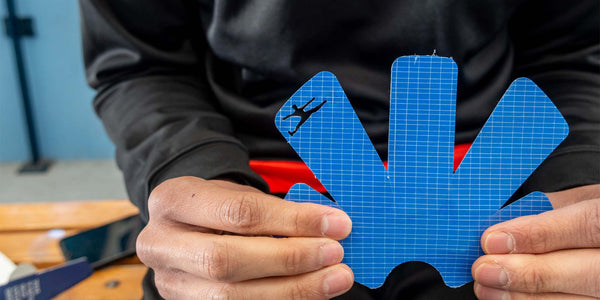
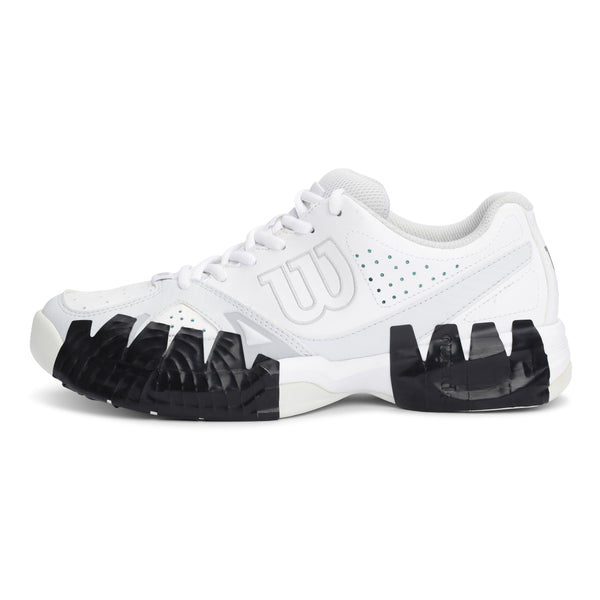
How it works: A friction patch such as Spraino is an ultra-low-friction strip applied to the outer edge of your indoor shoe, not to your body at all. It leaves your ankle completely free to move. During normal running, cutting and jumping your grip is unchanged, because the patch only engages when you land on the outer edge with the foot rolling. In that moment the shoe slides instead of catching, the foot realigns, and the twist that would have sprained your ankle never fully happens.
What the evidence says: Friction control has been tested in a randomised controlled trial published in the British Journal of Sports Medicine. The study reported:
- Over 90% reduction in the harmful forces acting on the ankle during a twist.
- 59% fewer serious non-contact ankle injuries.
- Up to two-thirds less total time lost to ankle injuries.
- A faster return to full speed for athletes who had already been injured.
You can read the peer-reviewed paper in the British Journal of Sports Medicine.
Trade-offs: The main advantage is that protection comes with no loss of mobility or comfort: nothing is strapped to your body. The limits are practical: patches are designed for indoor court shoes (tested for handball, badminton and volleyball, EU sizes roughly 37–47), a set lasts around 20–40 hours before it needs replacing, and they don't address ankle strength the way training does. They protect the landing, not the underlying joint.
The key difference: braces and tape stop your ankle from moving. Friction control stops your shoe from catching, so your ankle never gets forced into the twist in the first place.
Braces vs tape vs friction patches at a glance
| Criteria | Ankle braces | Athletic tape | Friction patches |
|---|---|---|---|
| How it works | Restricts ankle motion | Restricts ankle motion | Lets the shoe slide, freeing the ankle |
| Mobility | Reduced; can feel restrictive | Reduced at first, loosens over time | Unchanged; full natural movement |
| Durability | Reusable for months | Loosens in ~20–60 min; single use | ~20–40 hours per set |
| Effort each session | Put it on, no skill needed | Reapply every time, needs technique | Apply to shoe, reuse across sessions |
| Evidence | Strong, especially post-injury | Supportive, limited by loosening | Randomised controlled trial (BJSM) |
| Best for | Return from injury, unstable ankles | One-off matches, targeted support | Everyday prevention without restriction |
Which one is right for you?
Returning from a recent sprain? A brace is often the safest starting point. The evidence for bracing after injury is strong, and the extra mechanical stability matters most while ligaments are still healing. Many athletes then add friction control as they rebuild confidence and want their full range of motion back.
Playing a single big tournament? Tape is hard to beat for a one-off. It gives firm, customised support for the first part of the match, costs little per use, and you don't need to commit to anything longer term, just be aware it loosens as you play.
Want everyday protection and hate feeling restricted? This is where friction patches shine. If your ankles are basically healthy and your complaint with braces and tape is that they limit your movement, a friction patch protects the dangerous landing while leaving running, cutting and jumping to feel exactly as they always have.
Whatever you choose, keep training. None of these three replaces strong, well-balanced ankles. Balance and strength work over several weeks lowers your baseline risk, and it stacks with any of the methods above. The best protection combines a body that can handle the load with a solution that helps at the moment of a bad landing.
Frequently asked questions
Which is best for preventing ankle sprains: braces, tape or patches?
There is no single winner; it depends on your situation. Braces have the strongest evidence for athletes returning from injury. Tape is ideal for a single match but loosens within an hour. Friction patches, backed by a randomised controlled trial, protect the landing without restricting movement, which suits everyday prevention. Many athletes combine methods during a return to play.
Do braces or tape reduce ankle sprains more than friction patches?
They work in fundamentally different ways, so a direct ranking is misleading. Braces and tape restrict motion, and bracing in particular has solid post-injury evidence. Friction patches leave the ankle free and instead stop the shoe from catching; the published trial reported a 59% reduction in serious non-contact ankle injuries. The right choice depends on whether you value mechanical stability or unrestricted movement.
Can I use a friction patch and a brace at the same time?
Yes. They address different parts of the problem: a brace limits how far the ankle rolls, while a patch stops the shoe from catching, so they can complement each other. This combination is popular during the vulnerable return-to-play period, when some athletes want both mechanical support and reduced friction.
Does a friction patch make me slip during normal play?
No. A patch like Spraino sits on the outer edge of the sole and doesn't change your grip when the foot lands flat, so running, cutting and pushing off feel exactly as before. The low-friction surface only engages when you land on the outer edge with the foot in a steep, near-vertical position, the landing that normally rolls your ankle.
Which option is cheapest over a season?
It depends on how often you play. A brace is a one-time purchase reused for months, so its cost per session is low. Tape is inexpensive per roll but must be reapplied every session, so it adds up. A friction-patch set lasts around 20–40 hours of play before replacement. For frequent players, reusable options tend to be more economical than tape over a full season.