Ankle sprains are the most common injury in indoor sports like handball, badminton and volleyball, and most of them are non-contact, meaning nobody else caused them. The good news is that they are largely preventable. The most effective prevention combines four things: strong, well-balanced ankles, a proper warm-up, the right footwear, and reducing the friction that catches your shoe against the floor at the exact moment a sprain happens. This guide explains why lateral ankle sprains occur on court and what actually works to stop them.
Why ankle sprains happen on indoor courts
A classic lateral (outward) ankle sprain follows a predictable pattern. You land from a jump or change direction quickly, your foot rolls onto its outer edge, and instead of sliding, the sole of your shoe grips the floor. Because the shoe is stuck, all the rotational force is absorbed by the ligaments on the outside of your ankle. If the load is high enough, those ligaments tear. That is a sprain.
Indoor sports floors are designed for grip, which is exactly what you want when you're pushing off and sprinting. But that same high friction becomes the problem in the split second your foot is landing on its edge. The injury isn't caused by weakness alone. It's caused by a shoe that catches when it should let go.
What the research shows
Friction control at the shoe is not a marketing idea. It has been tested in a randomised controlled trial and published in the British Journal of Sports Medicine, one of the most respected journals in sports science. The study looked at applying an ultra-low-friction patch to the outer edge of indoor shoes and measured the effect on lateral ankle sprains.
- Over 90% reduction in the harmful forces acting on the ankle during a twisting movement.
- 59% fewer serious non-contact ankle injuries.
- Up to two-thirds less total time lost to ankle injuries.
- A faster return to full speed for athletes who had already been injured.
You can read the peer-reviewed paper in the British Journal of Sports Medicine.
How to prevent ankle sprains: six evidence-based methods
1. Build ankle strength and balance
Balance (proprioceptive) training is one of the best-supported ways to reduce ankle sprains, especially if you've sprained before. Simple single-leg balance work, wobble-board or cushion drills, and calf and peroneal strengthening a few times a week measurably lower your risk. It takes weeks to build, so start well before your season peaks.
2. Warm up properly before you play
A structured warm-up that includes dynamic movement, hops and direction changes prepares the ankle for the loads it's about to take. Programmes built around this idea have been shown to cut lower-limb injuries across team sports. Five to ten focused minutes is enough.
3. Choose the right footwear
A well-fitting indoor court shoe with a stable heel and good lateral support gives your ankle a solid base. Replace shoes once the midsole is worn. A compressed, uneven sole makes rolling more likely. Footwear alone won't prevent every sprain, but the wrong shoe makes one more likely.
4. Weigh up bracing and taping
Braces and tape work by physically limiting how far your ankle can move. They can help, particularly in the months after an injury, and the evidence for bracing is reasonably strong. The trade-off is comfort and mobility: many athletes find braces restrictive, and tape loses its hold within an hour and has to be reapplied. They reduce movement to reduce risk, which is not the same as keeping you moving naturally.
5. Reduce friction at the point of injury
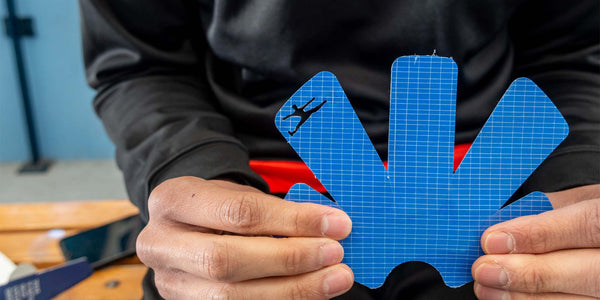
This is the newest and most targeted approach, and the one backed by the trial above. Instead of restricting your ankle, a low-friction patch such as Spraino is applied to the outer edge of your shoe. During normal running, cutting and jumping your grip is unchanged. The patch only takes effect when you land on the outer edge with the foot rolling. In that moment the shoe slides instead of catching, the foot realigns, and the twist that would have sprained your ankle never fully happens. You keep full mobility and comfort, and the protection kicks in exactly when you need it.
The key difference: braces and tape stop your ankle from moving. Friction control stops your shoe from catching, so your ankle never gets forced into the twist in the first place.
6. Respect recovery and avoid re-injury
The single biggest risk factor for an ankle sprain is having had one before. If you're coming back from an injury, don't rush it: complete your rehabilitation, rebuild strength and balance, and add extra protection during the vulnerable return-to-play period. Re-injuries are common precisely because athletes return before the ankle is ready.
Which methods work best together
No single method is a magic bullet, and the strongest prevention stacks a few of them. A practical, evidence-based routine looks like this: train balance and strength through the week, warm up before every session, play in a proper court shoe, and control friction at the shoe so a bad landing slides instead of catching. If you've sprained before, add bracing during your return and be patient with recovery. Together these address both sides of the problem: a body that can handle the load, and a shoe that won't trap your foot when it matters.
Frequently asked questions
What is the most common cause of ankle sprains in indoor sport?
Most are non-contact lateral sprains: the foot lands on its outer edge, the shoe grips the floor instead of sliding, and the outer ankle ligaments take the full rotational load. High-friction indoor floors make this more likely.
Can you really prevent ankle sprains, or just treat them?
You can meaningfully reduce your risk. Balance and strength training, proper warm-ups, good footwear, bracing where appropriate, and friction control at the shoe have all been shown to lower ankle-sprain rates. Prevention doesn't mean zero risk, but the reduction is real and well documented.
Are ankle braces or friction patches better?
They solve the problem differently. Braces and tape restrict how far the ankle can move, which reduces risk but also limits natural motion. A low-friction patch leaves your movement completely free and instead stops the shoe from catching at the moment of a bad landing. Many athletes prefer friction control because it protects without restricting, and some use both during return from injury.
Does reducing friction make me slip during normal play?
No. A patch like Spraino sits on the outer edge of the sole and doesn't change your grip when the foot lands flat, so running, cutting and pushing off feel exactly as before. The low-friction surface only engages when you land on the outer edge with the foot in a steep, near-vertical position, the landing that normally rolls your ankle.
How long does it take to lower my ankle-sprain risk?
Balance and strength training take several weeks to build a protective effect, so start early. Footwear and friction control work immediately, from the first session you use them. Combining a longer-term training habit with same-day protection gives you the best of both.